Tinnitus Treatment in India: What Actually Works (And What to Skip)

If you have been searching for tinnitus treatment in India, you have probably met two extremes: the short appointment that ends with, “Your ears look fine. You’ll have to live with it,” and the advertisement promising that a tablet, oil, or device will silence the ringing for good.
Neither is a fair picture of good care. There is currently no universally accepted cure that removes tinnitus for everyone. Clinical guidance supports structured ways to reduce how much tinnitus interferes with sleep, concentration, mood, and daily life. Many people do regain a sense of control, even if the sound remains.
Here is what the evidence supports, what to be cautious about, and how to start in India, online or near you.
First, be clear about what “treatment” can mean
Tinnitus is a symptom, not a disease: the perception of sound — ringing, buzzing, hissing, or roaring — without an external source. It is common, often linked with hearing changes, noise exposure, stress, or ear conditions, and in most cases is not immediately dangerous. For a plain-language introduction, see why your ear may be ringing.
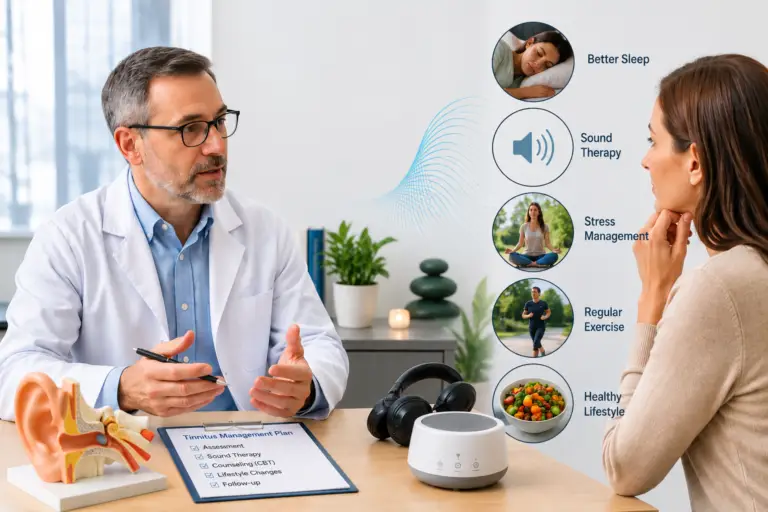
Treatment is not one procedure that works the same way for every person. For some, the sound fades as an underlying issue settles. For persistent tinnitus, the aim is usually to rule out causes that need medical attention; reduce distress and constant monitoring of the sound; improve sleep, focus, and quality of life; and support habituation — the process by which the brain learns to treat tinnitus more like a fridge hum: still there sometimes, but no longer in charge.
What the evidence actually supports
The UK’s NICE guideline on tinnitus (NG155) and the AAO-HNSF 2026 tinnitus guideline update both emphasise careful assessment, clear education, and personalised management — not a single miracle therapy.
1. A proper assessment, not a two-minute reassurance
Start with a thorough history and a hearing evaluation. NICE recommends offering an audiological assessment to people with tinnitus. The 2026 AAO-HNSF update likewise stresses a full hearing evaluation and asks clinicians to take emotional distress seriously.
That usually means onset, whether the tinnitus is one-sided or pulsatile (in time with your pulse), its effect on sleep and mood, and a full audiogram — not only a glance at the eardrum. Imaging is not routine. If you were told “everything is normal” after a very brief visit, it is reasonable to ask for this kind of assessment.
2. Cognitive behavioural therapy (CBT) for tinnitus-related distress
CBT has the strongest research base for the impact of tinnitus. A Cochrane review of 28 studies found that CBT may reduce the negative impact of tinnitus on quality of life at the end of treatment, with few reported harms. NICE recommends a stepped approach that includes tinnitus-related CBT when tinnitus is still affecting daily life after initial support. The 2026 AAO-HNSF update also recommends CBT for persistent, bothersome tinnitus.
CBT does not switch the sound off. It helps you work with thoughts and habits that keep the nervous system on high alert: “This will never stop. I will never sleep.” When that alarm quiets, many people find the tinnitus easier to live with. We write more in Therapy for Tinnitus. In India, tinnitus-focused CBT can be hard to find, so guided online care can help if it is personalised, not just a generic app.
3. Hearing aids when hearing loss is present
Tinnitus and hearing loss often travel together, even when conversations still feel “mostly fine.” NICE advises offering amplification when hearing loss affects communication, and considering it when hearing loss is present but conversations are manageable. Do not fit hearing aids for tinnitus when hearing is normal. The 2026 AAO-HNSF update supports evaluating hearing aids when hearing difficulties are present.
A hearing aid is not a cure. By restoring some environmental sound and reducing listening effort, it can make tinnitus less prominent for many people who also have hearing loss. A proper audiogram and a carefully run trial are the honest way to know.
4. Sound enrichment, counselling, and TRT
Soft, steady background sound — a fan, rain, pink noise, or a sound generator — can reduce the contrast of tinnitus in a quiet room. Use a comfortable level, often just below the tinnitus, rather than blasting over it. NICE did not make a firm recommendation on sound therapy alone; the 2026 update says sound enrichment may be offered as part of care. See our sound therapy guide. If ordinary sounds already feel painfully loud, you may also have hyperacusis — all-day earplugs or total silence can make sensitivity worse.
Education often lowers fear on its own. Tinnitus Retraining Therapy (TRT) combines structured counselling with sound therapy and aims at habituation. Results are mixed; it should not be sold as a guaranteed or only option. The ATA overview of CBT and TRT is a balanced starting point.
What to view with caution in India
India has excellent ENT surgeons and audiologists — and a noisy marketplace of “tinnitus cure” claims. Be wary of any product that guarantees silence; no responsible clinician can promise that.
Routine medicines and supplements are not a standard tinnitus treatment. The 2026 AAO-HNSF guideline recommends against routinely using them, and NICE recommends not offering betahistine to treat tinnitus. Some tablets may still be appropriate for a related ear condition — ask what the medicine is for. New or expensive devices, including “neuromodulation” programmes, deserve questions about the evidence and about what happens if they do not help. See our overview of tinnitus clinic fees in India.
How care typically works in India — and when not to wait
Many people start with an ENT specialist, especially if the tinnitus is new, one-sided, pulsatile, or paired with hearing change or dizziness. That medical review matters. For ongoing management, a tinnitus-trained audiologist can work on counselling, sound plans, hearing-aid decisions, and CBT-informed strategies.
If you are not near a dedicated service, video consultation can cover education, counselling, and planning. You may still need in-person hearing tests or an ENT visit locally. Tinnitus Connect works online with patients across India and with English-speaking patients abroad.
Most tinnitus is not an emergency. Seek prompt medical care if you notice sudden hearing loss; facial weakness, severe vertigo, or possible stroke symptoms; new pulsatile tinnitus; or tinnitus only in one ear that is not settling. If you feel unsafe, contact local emergency services or a mental-health crisis line immediately. For longer-standing tinnitus that mainly affects sleep, work, or mood, a planned assessment is the right next step.
A calm next step
You do not have to choose a treatment from a list of advertisements tonight. You do need a clear picture of your hearing and a plan that is honest about what can change.
If you would like that conversation, book an appointment, WhatsApp or call 9550100693, or use the form on tinnitusconnect.com. We can help you decide whether an online consult or an in-person visit near you is the better first step. See also our tinnitus care programme.
This article is for education. It is not a diagnosis or a substitute for personal medical advice.
Frequently asked questions
What is the most effective tinnitus treatment in India?
There is no single treatment that works for everyone. CBT has the strongest evidence for tinnitus-related distress. Hearing aids can help when hearing loss is present, and counselling or sound enrichment are often useful in a personalised plan. A proper assessment is the right starting point.
Can tinnitus be cured completely?
Sometimes tinnitus improves or settles, depending on the cause. For persistent tinnitus, no treatment can honestly guarantee complete elimination. Many people still get substantial relief through habituation and evidence-based management.
Should I see an ENT or an audiologist first?
If tinnitus is sudden, one-sided, pulsatile, or comes with hearing loss, dizziness, or neurological symptoms, see an ENT promptly. For longer-standing tinnitus that affects sleep or quality of life, a tinnitus-trained audiologist can often build the management plan. Many people benefit from both.
Is online tinnitus treatment in India legitimate?
Online care can be appropriate for counselling, education, and follow-up, and CBT for tinnitus is often delivered digitally. You may still need an in-person hearing test or ENT review. Choose a qualified clinician, and be wary of programmes that only sell a product.
Sources
- Fuller T, Cima R, Langguth B, et al. Cognitive behavioural therapy for tinnitus. Cochrane Database of Systematic Reviews, 2020. Cochrane summary
- NICE. Tinnitus: assessment and management (NG155), 2020. Guidance
- AAO-HNSF. Clinical Practice Guideline: Tinnitus Update, October 2026. Academy resource page and plain-language bulletin summary
- American Tinnitus Association. CBT versus TRT
- Tinnitus UK. tinnitus.org.uk
Reviewed by an experienced audiologist specialising in tinnitus
This article is for general information and isn't a substitute for personal medical advice. See a doctor promptly for sudden hearing loss, or tinnitus in one ear or that pulses with your heartbeat.